01 · BOARD
CHOOSE A FLOOR
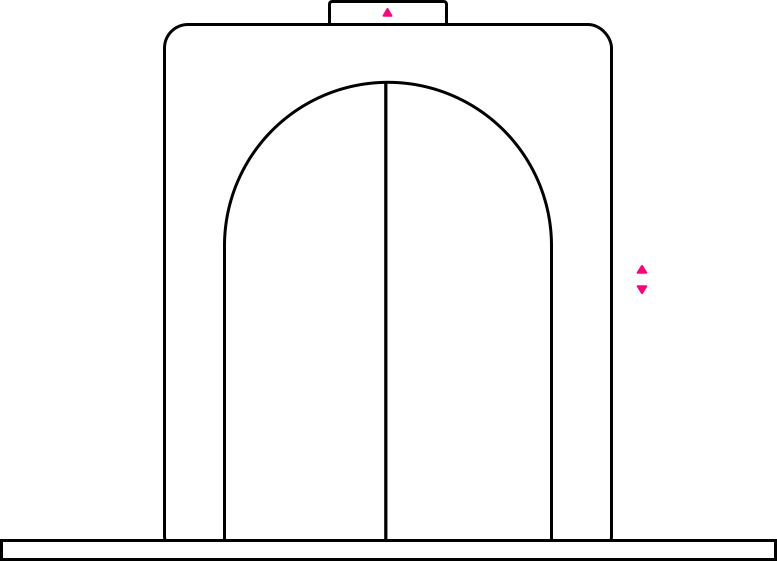
Commit ELE to the Elevator Car and select a destination floor above the active floor.

Elevator is an autonomous algorithmic monetary issuance protocol built using Uniswap v4 hooks. Every organic swap is both market activity and a protocol clock tick: the hook observes conditions, queues eligible work, and advances one bounded task on the next swap.
Elevator launches 50,000 ELE across five permanent, one-sided v4 positions with zero contributed WETH. Active launch ranges provide approximately 6.43 WETH of virtual depth—not treasury WETH. Trading then produces the observations, fees, and reserves that move the protocol toward higher floors.
The ELE/WETH market establishes price, produces fees, and clocks the autonomous state machine.
WETH and ELE flows build reserves for compression, coverage, and future expansion.
The hook checks price persistence, fees, liquidity, reserves, capacity, and time on swaps.
A later swap executes the next eligible stage: authorization, tranche, liquidity, or cleanup.
Expansion is the result of that full sequence—not a reaction to a single trade and not an operator decision. When every condition passes, the hook advances the Staircase Controller from ordinary market traffic. Multi-stage work is deliberately spread across later swaps so execution remains bounded.
Reserve inventory may carry no more than 60% of a floor. Newly issued money always supplies at least 40%, subject to fee-earned capacity and hard issuance caps.
The Elevator Hook runs inside the ELE/WETH pool lifecycle. It does more than observe and charge fees: every organic swap checkpoints the protocol, and the following swap's active PoolManager unlock can advance one deterministic task.
Before and after each organic swap, record observations and evaluate qualification or abandonment.
Mark a next-swap automation pass after settlement. Quiet markets need no heartbeat transaction.
Attempt one gas-capped transition, compression, liquidity task, fee harvest, or overflow burn.
No keeper is paid or required. Candidate failures are caught inside a fixed gas envelope, so ineligible work cannot block the trader. Public transition functions remain recovery fallbacks, not the normal operating model.
VIEW THE TECHNICAL MECHANISMEach floor is 18.1262% above the last and earns a fixed 0.10% launch-supply quantum. The ratio is derived from 0.6% supply elasticity. Select one below to inspect the staircase.
F0 is the starting floor, n is the floor index, and r is the elasticity-derived step ratio. Every cleared floor authorizes exactly 50 ELE of gross expansion.
Before supply can expand, demand must persist across both price windows while fees, liquidity, reserve coverage, mint capacity, and timing all remain within policy. The controller evaluates every gate together.
Buy-side activity builds WETH reserves. Sell-side activity and compression build ELE inventory. The same swap stream autonomously checks qualification, executes compression, advances earned floors, deploys permanent liquidity, harvests fees, and clears stale work. Supply expands only when the market earns uncleared floors—without a keeper, maintenance bot, or app button.
The hook applies a monetary fee to swap input alongside the 0.30% pool LP fee. Rates shift with protocol state. No slice funds executors: autonomous work is bundled into organic swaps and the monetary remainder stays in protocol reserves.
The remaining monetary fee splits 60% to Buyback Reserve and 40% to Stability Reserve.
Every remaining ELE fee settles into the Reserve Vault as excluded Ascent inventory.
Choose a destination Car and commit ELE to it. Time builds eligibility and distance builds mining power. You never authorize or settle an ascent: organic swaps drive the v4 hook, and the hook automatically distributes 88% of each earned floor to eligible Curve Miners. No ascent, no mining reward.
Commit ELE to the Elevator Car and select a destination floor above the active floor.
Eligibility begins after 15 minutes. Mining weight grows with time and reaches full maturity after four hours.
Farther destination floors can increase position weight, subject to the protocol's destination-factor cap.
When the market earns a floor, later organic swaps make the hook authorize and settle it. Eligible positions are credited automatically, with no keeper or miner transaction.
Elevator coordinates market fees, reserve activity, floor qualification, compression, liquidity, and supply allocation as a self-advancing monetary cycle. Organic ELE/WETH swaps are its clock; no keeper fleet or maintenance interface is part of production operation.
Independent project. Not affiliated with or endorsed by Robinhood Markets, Robinhood Crypto, Robinhood Chain, Uniswap Labs, or the Uniswap Foundation. Uniswap is a trademark of Uniswap Labs; all other third-party marks belong to their respective owners. No financial advice. Experimental software; use at your own risk. Read the full disclaimer.